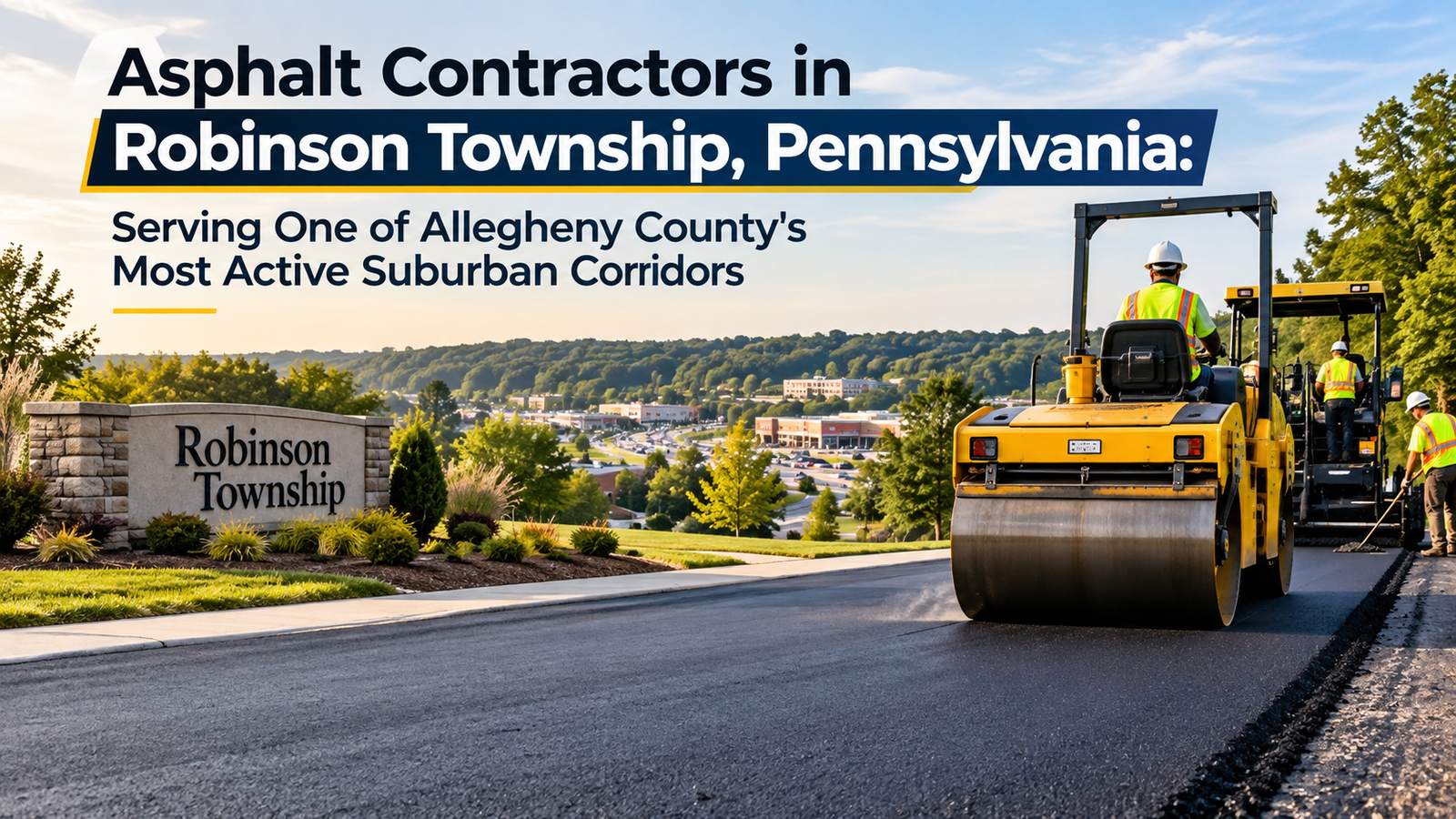
Robinson Township sits in the western reaches of Allegheny County, immediately west of Pittsburgh and bordered by Findlay Township and the Ohio River to the north and west. The township is one of the most commercially active communities in the Pittsburgh region anchored by the Settler’s Ridge and The Mall at Robinson commercial centers along the US-22/30 corridor, with significant office, hospitality, and industrial development filling in along the PA-60 spine that links the Pittsburgh International Airport to the south with the Ohio Valley communities to the north. This commercial intensity makes Robinson Township one of the most active Asphalt Contractor Robinson Township paving markets in western Pennsylvania a community where parking lot maintenance, commercial resurfacing, and industrial paving are in constant demand alongside the residential driveway work that suburban neighborhoods throughout the township generate.
Robinson Township’s Geography and What It Means for Paving
Robinson Township’s terrain reflects the ridgeline-and-valley character typical of western Allegheny County. The commercial corridor along US-22/30 occupies a relatively flat plateau, which is why it became one of the region’s primary retail destinations flat land in this part of Pennsylvania is development-favorable and comparatively scarce. But the residential neighborhoods that fill the surrounding ridges and valleys have the grade changes, narrow access roads, and hillside driveway configurations that define residential paving in western PA.
The underlying geology of Robinson Township follows the Pittsburgh-area pattern of glacial till and residual clay soils over bedrock that is predominantly shale and sandstone. The clay-rich till is compressible, frost-susceptible, and drains poorly all characteristics that asphalt contractors must account for through adequate base depth, proper subgrade preparation, and drainage design. Robinson Township’s position in Allegheny County means it receives the Pittsburgh region’s typical 36 to 40 inches of annual precipitation, with significant winter snowfall, spring rain, and the freeze-thaw cycling that western Pennsylvania winters consistently produce.
The Commercial Paving Market in Robinson Township
The scale of retail and commercial development in Robinson Township creates a paving demand environment that distinguishes it from most neighboring communities. The Settler’s Ridge center, The Mall at Robinson, and the surrounding commercial strips along US-22/30 collectively represent millions of square feet of retail and restaurant space with equally vast parking lots that require continuous maintenance. These lots handle high volumes of passenger vehicle traffic, regular delivery truck access, and the stress of western Pennsylvania winters a combination that produces predictable deterioration patterns that professional asphalt contractors address through maintenance programs calibrated to the specific use patterns of each property.
Commercial parking lot maintenance in Robinson Township operates on a cycle that reflects the Allegheny County climate and the specific intensity of use at each property. High-traffic retail lots in the Settler’s Ridge area may see sealcoating on a 2 to 3-year cycle, with crack sealing performed annually before each winter season and re-striping whenever markings fade to the point of reduced legibility. Lower-traffic office and hospitality properties might operate on a 3 to 5-year sealcoating cycle with monitoring for crack development between cycles. The guiding principle in both cases is that proactive maintenance at the right point in the pavement lifecycle is dramatically less expensive than rehabilitation after significant deterioration.
Pennsylvania’s ADA accessibility standards require that commercial parking facilities in Robinson Township maintain properly configured accessible spaces correct number based on lot capacity, minimum 8-foot width for standard accessible spaces and 11-foot width for van-accessible spaces, access aisle width requirements, maximum 2-percent slope in any direction within the accessible area, and proper signage. Commercial paving projects in Robinson Township should incorporate a current ADA compliance review as a standard component of the scope, bringing any deficiencies into compliance during the project rather than leaving them as ongoing liability exposure.
Industrial and Logistics Paving Near Robinson Township
Robinson Township’s location at the intersection of PA-60, US-22/30, and proximity to Pittsburgh International Airport has attracted industrial, logistics, and distribution facilities that represent a distinct and demanding paving category. Industrial pavement must be designed for the loading conditions of the specific facility not the passenger vehicle loading that commercial parking lots experience, but the repeated heavy axle loads of delivery trucks, the static loading of parked trailers, and in some cases the concentrated loads of forklifts and heavy equipment operating within the facility yard.
Heavy industrial pavement in the Robinson Township area typically requires significantly thicker asphalt sections than commercial or residential applications 5 to 8 inches or more of hot mix asphalt over 10 to 14 inches of aggregate base for areas handling constant heavy truck traffic. Loading dock aprons, the areas immediately in front of dock doors where trailers are positioned and where the most concentrated static loading occurs, are the highest-stress zones in any industrial paving application and often warrant concrete aprons rather than asphalt at the critical load points.
Residential Paving in Robinson Township Neighborhoods
Behind the commercial corridors, Robinson Township contains substantial residential neighborhoods the established communities of Church Hill, Ingram Run, and the various subdivisions and rural-residential developments that fill the township’s hillside terrain. Residential driveway paving in Robinson Township follows the pattern familiar throughout western Allegheny County: clay subgrade requiring careful base preparation, hillside grades on many properties requiring drainage management, and the western Pennsylvania freeze-thaw climate demanding consistent maintenance.
Robinson Township’s newer residential developments, particularly those built in the 1990s and 2000s, have driveways that are now entering the phase of their lifecycle where serious deterioration is beginning. A driveway installed in 1995 is now 30 years old at the end of a well-maintained driveway’s expected lifespan and well past the expected lifespan of one that hasn’t been consistently maintained. Property owners in Robinson Township’s established subdivisions who haven’t addressed their driveways in many years are often looking at reconstruction rather than simple resurfacing.
For Robinson Township homeowners whose driveways are in moderate condition showing surface cracking and oxidation but without the alligator cracking that signals base failure mill-and-overlay resurfacing provides a cost-effective path to 8 to 15 additional years of functional life. The milling machine removes the deteriorated surface layer to a consistent depth, creating a clean bonding surface for the new asphalt overlay while maintaining existing grade relationships at garage thresholds, curbs, and drainage outlets. The milled material (reclaimed asphalt pavement, or RAP) is hauled to regional asphalt plants where it’s incorporated into new mixes.
PA-60 Corridor and the Airport-Region Paving Market
The PA-60 corridor that runs through Robinson Township to Pittsburgh International Airport drives a specific category of commercial and institutional paving: hotel properties, airport-related facilities, corporate campuses, and the car rental and transportation businesses that cluster near major airports. These properties have paving needs that blend commercial parking requirements with the intensity of use patterns associated with high-turnover customers and operations that run continuously. The car rental lots south of the terminal, the hotel properties along the PA-60 spine, and the corporate campuses along the Cherrington Parkway all represent segments of Robinson Township’s paving market with specific maintenance requirements.
Common Questions About Asphalt Contractors in Robinson Township
How long should a commercial parking lot last in Robinson Township before needing reconstruction? A properly installed commercial parking lot in Allegheny County, maintained with sealcoating, crack sealing, and prompt pothole repair, should have a functional lifespan of 20 to 25 years before full reconstruction is warranted. Lots that see consistent heavy truck traffic deteriorate faster. Lots that receive no maintenance may need reconstruction in 10 to 12 years.
Does Robinson Township have specific permit requirements for asphalt paving? Commercial paving projects in Robinson Township that affect stormwater runoff, modify drainage patterns, or involve significant impervious surface area may require permits from the township and potentially from the Allegheny County Conservation District for stormwater management compliance. Residential driveway replacement on an existing footprint typically doesn’t require a permit. Confirm specific requirements with the Robinson Township Municipal Building before starting any commercial paving project.
What mix design is appropriate for Robinson Township parking lots with heavy truck traffic? For areas handling regular heavy truck or delivery vehicle traffic, polymer-modified asphalt binder (typically PG 76-22 for the Pittsburgh region) provides better rut resistance at summer pavement temperatures than standard PG 64-22 binder. The improved high-temperature performance reduces rutting in wheel paths and at dock approaches, which are the first areas to show distress in conventional asphalt under heavy loading.